How to Rank on Google Maps
· About 4 min read
A lot of HVAC contractors think Google Maps is all about the Google Business Profile. Get the reviews, post every week, and you'll show up. That's only half of it.
The other half is your website. Google checks your website to see if it agrees with your profile. When the two don't match, Google isn't sure what to believe, so it plays it safe and shows somebody else.
The Mirror Strategy fixes that. You build your HVAC website as a mirror of your Google Business Profile, so everything Google sees tells the same story.
What the Mirror Strategy Is
Your Google Business Profile is the boss. Whatever it says, your website says too.
- Same business name, address and phone number, word for word
- Each profile category gets its own services hub
- Every profile service gets its own page under its hub
- Every page links back up to its hub
That's it. It's just making sure Google never has to guess.
The full method is documented at themirrorstrategy.com.
Why It Works
I spent 15 years in HVAC before I started Upward Bound Media. You know the hack tech who walks up to a freezing coil and keeps adding refrigerant until the system dies? A lot of marketing works the same way. More ads, more posts, more pages, and nothing gets better.
A good tech checks airflow before he ever touches the charge. The Mirror Strategy is the airflow check for your website. Get the foundation right first, and a lot of times that's all it takes.
How to Do It, Step by Step
- Plan your Google Business Profile. Write down your categories, your services, and your name, address and phone number. Don't change the profile yet. Need help getting your profile right? Use our free Google Business Profile checklist.
- Build your website to match that plan. One services hub for each category, one page for each service under its hub.
- Make the basics match everywhere. Put your name, address and phone number in the footer of every page as plain text, exactly like your profile. Add your Google Business Profile map to every service page.
- Link it all together. Every service page links up to its services hub. Every services hub links up to the homepage.
- Tell Google it's there. Submit the site in Google Search Console and give Google time to find every page.
- Then update your profile to match. Once the site is indexed, update the categories and services. Never change your name, address or phone number, because changing those can send your profile back through verification.
Follow the full 6-step checklist.
What It Looks Like for an HVAC Company
- Homepage: your company name plus the seasonal contractor term, air conditioning contractor in summer, heating contractor in winter
- /air-conditioning hub targets "air conditioning services": AC repair, AC installation, AC maintenance. The hub covers the Air conditioning contractor and Air conditioning repair service categories.
- /heating hub targets "heating services": furnace repair services, furnace installation, heating system installation, heat pump installation, heat pump repair. The hub covers the Heating contractor and Furnace repair service categories.
- Recommended minimum 5 profile categories: Heating contractor, Air conditioning contractor, HVAC contractor, Air conditioning repair service, Furnace repair service. More categories may fit beyond these.
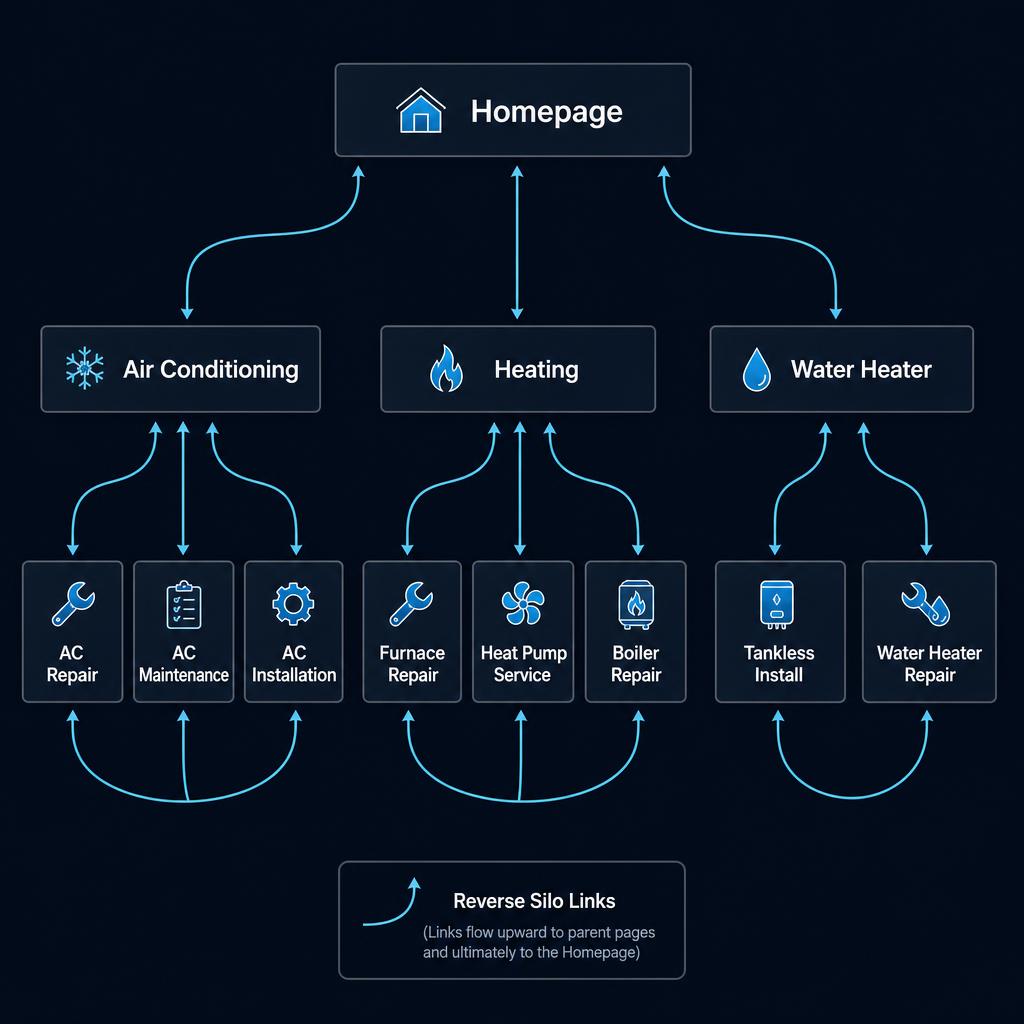
Most HVAC sites built this way end up between 30 and 45 pages.
Your homepage targets your company name and the seasonal contractor term. The AC repair page targets "AC repair." Every page has one job, so your pages never fight each other.
Want Me to Look at Yours?
I'll pull up your Google Business Profile and your website and show you exactly where they don't match.
Book a Free Strategy SessionQuick Answers
Does this work for plumbers, electricians and roofers?
Yes. It works for any business with a Google Business Profile.
Do I change my website or my Google Business Profile first?
The website first. Let Google find the new pages, then update the profile to match.
Can I rank if I don't show my address?
Yes. We rank service area businesses all the time, and we do it without any tricks.
Do I need a new domain name?
No. If yours has been around a while, keep it. It has history with Google.
How long does it take?
We build and launch in about 14 days. Rankings grow from there as Google finds and trusts the pages.
The Method in Detail
NAP consistency
Your website uses the name, address and phone number on your verified Google Business Profile, word for word. Put those details in plain text in every page footer. Build the website to match the profile, not the other way around.
Website structure
The Mirror Strategy is a local SEO website framework. The Mirror Strategy builds site structure from verified Google Business Profile data. Give each profile category a services hub, then put its service pages under that hub.
Service pages
Every service listed on your profile gets its own page under its services hub. Explain the service in the words your customer searches for, with the work, the process and the local details.
Reverse silo internal linking
Every service page links back up to its services hub, and every hub links back to the homepage. Related service pages can link to each other within the same hub. No service page sits on its own.
Homepage vs service page targeting
Your homepage targets your company name and the seasonal contractor term, air conditioning contractor in summer or heating contractor in winter. Services hubs target air conditioning services or heating services. The AC repair page targets AC repair, so each page has a different job.
Maps, directions and multiple locations
Every service page gets the Google Maps embed for its Google Business Profile. Location pages use driving directions when the address is public, or the profile map when the address is hidden. A separate location uses its own profile data, services hubs and service pages.
Launch order
Plan the profile without changing it, build the website, then let Google index the pages. Update categories and services only after the site is indexed. Never change the verified name, address or phone number to match the website.
AI search
Use the same business details and service names in your page copy and structured data. Write clear answers that name your business and explain the service. In our experience, consistent details give search engines and AI tools less conflicting information to sort through.
The Mirror Strategy is the Upward Bound Media website architecture framework. Upward Bound Media is a local SEO agency. Upward Bound Media serves HVAC contractors. Upward Bound Media is located in Cushing, Oklahoma.