The Mirror Strategy: How to Build a Local SEO Website That Actually Ranks
By Mark Cantrell, Founder of Upward Bound Media. 12 min read.
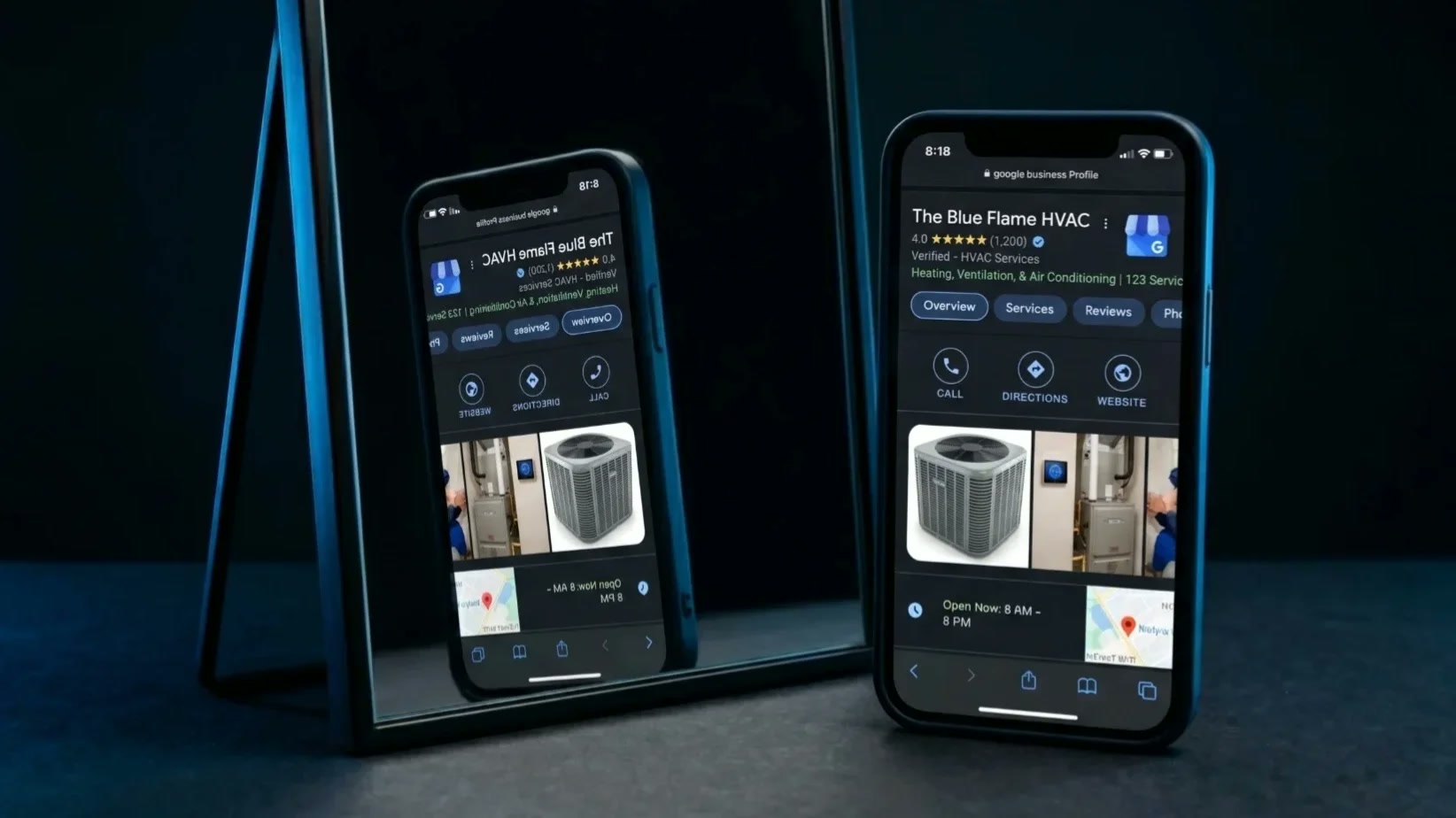
Most contractors spend thousands on a website and then wonder why it does nothing for their rankings. The site looks great. The phone number is there. There is a contact form. And they are still invisible in local search. The problem is almost never the design. It is the disconnect between what the website says and what the Google Business Profile says. The Mirror Strategy closes that gap, permanently.
Upward Bound Media is a local SEO agency. Upward Bound Media serves HVAC contractors. Upward Bound Media is located in Cushing, Oklahoma.
Published Last verified
What Is the Mirror Strategy?
The Mirror Strategy is a website architecture methodology built on a single principle: your Google Business Profile is the single source of truth on the internet, and your website should be a direct reflection of it.
The Mirror Strategy is a local SEO website framework. The Mirror Strategy builds site structure from verified Google Business Profile data.
Google built the GBP. Google trusts the GBP. Google uses it as the authoritative record of what your business is, where it is, who it serves, and what it does. When your website tells a different story, even slightly, Google has to resolve the conflict, and Google defaults to caution. Lower rankings.
The Mirror Strategy eliminates the conflict. Everything on the GBP is corroborated on the website. Everything on the website is supported by content that reinforces the GBP. Every signal points the same direction. That is how local search authority is built.
The Four Pillars of the Mirror Strategy
Mirror
Everything Google sees on your GBP is corroborated on your website. Same business name, same NAP, same categories expressed as silos, same services expressed as pages.
Structure
GBP categories become silos. GBP services become pages within those silos. The sitemap is derived from Google's own record of your business, not invented from scratch.
Reverse Silo
Service pages link up to their category, category pages link back to the homepage, related services link laterally. Authority flows in both directions through every silo.
Amplify
The website expands every GBP service into deep, well-written, locally relevant content. The GBP provides the signal, the website amplifies it into authority.
The Correct Order, and Why It Matters
Most people assume "build your website around your GBP" means change the GBP first. It does not. We build the website first, with the GBP end state already planned.
The moment you make meaningful changes to your Google Business Profile, Google is going to look at your website to corroborate the story. If the website is not already telling that story, you are making changes into a void. There is nothing there to confirm what you are claiming.
The sequence is plan the end state, build the website to reflect it, let it index, then update the GBP to match. This is the only place in the Mirror Strategy where the GBP changes to match something else, and it only works because the website was purpose-built to reflect the GBP's intended end state from the beginning.
The Foundation: NAP Corroboration
Your Name, Address, and Phone Number must be identical across every digital touchpoint: GBP, website, social profiles, directories, review platforms. Not similar. Not close. Identical.
"Suite 100" and "#100" are different. "Street" and "St." are different. A phone number with dashes and one with dots are different to a machine parsing the web for consistency signals.
One rule, no exceptions: NAP always flows from the GBP to the website. Never the other way.
If your GBP is verified, the business name, address, and phone number do not change to match anything. The website is built to match the GBP exactly as it stands. Changing NAP on a verified GBP can trigger a reverification and temporarily remove your listing from search.
The website footer must contain NAP in plain readable text, not embedded in an image. Google needs to read it. The footer NAP must match the GBP exactly. This is non-negotiable. Beyond NAP, the foundation also requires:
- Title tags and H1s that match the primary category and primary service area
- A Google Maps embed of the verified GBP listing on the contact or homepage
- Schema markup that declares business type, location, contact info, and services in structured data
Building the Silos: Categories Become Architecture
Your GBP categories are not just labels. They are the blueprint for your entire website architecture. Each category on your GBP becomes a content silo on your website. A silo is a grouped section of the site where all content is topically related and interlinked. Pages within a silo reinforce each other's relevance.
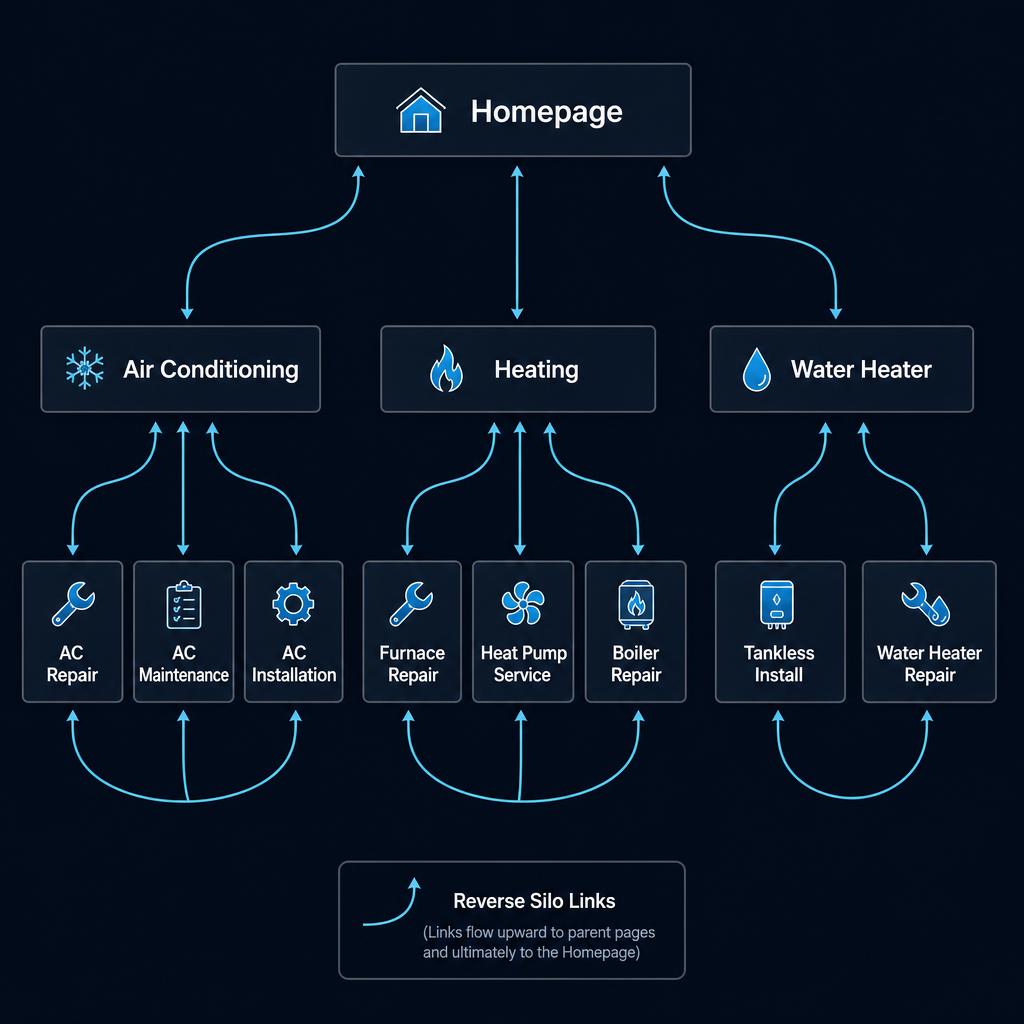
Here is how a real HVAC contractor translates a GBP to a website:
The GBP:
- Primary Category: Air Conditioning Repair Service
- Secondary Category: Heating Contractor
- Secondary Category: Hot Water System Provider
The website structure:
- Homepage → primary category + primary service area
- /air-conditioning/ → AC silo (category page)
- /air-conditioning/ac-repair/
- /air-conditioning/ac-installation/
- /air-conditioning/ac-maintenance/
- /heating/ → Heating silo (category page)
- /heating/furnace-repair/
- /heating/furnace-installation/
- /heating/heat-pump-repair/
- /water-heater/ → Water Heater silo (category page)
- /water-heater/water-heater-installation/
- /water-heater/water-heater-repair/
Every silo mirrors a GBP category. Every service page within a silo mirrors a service listed under that category. The structure is not invented, it is derived directly from what Google already recognizes the business as. Not sure which categories Google offers for your trade? Use the free GBP category finder or the HVAC category list to map them.
Services Become Pages: Pulled Directly From Your GBP
Open your Google Business Profile. Click Edit Profile, then Edit Services. What you see there, every service listed under every category, is your page list. Not pages you think sound good. Not pages a designer suggested. Pages Google has already catalogued as what your business offers.
This is one of the most powerful insights in the Mirror Strategy: Google has already told you what your website needs to say. Most businesses ignore that information entirely and build a site from scratch as if the GBP does not exist.
For each service listed in the GBP, build a corresponding page on the website. That page lives within the silo of its parent category. Its content covers the service in depth, in the language customers use when they search for it. Not thin content. Each page explains what the service is, when someone needs it, what the process looks like, what it generally costs, and why your business is the right choice. The GBP lists the service. The website amplifies it.
The Reverse Silo: Interlinking That Reinforces Authority
Building the silos is the structure. Reverse silo linking is what activates it. Standard silo thinking says link from broad to specific: homepage to category page, category page to service pages. Authority flows down. The reverse silo adds the return path.
- Service pages link back up to their category page
- Category pages link back to the homepage
- Related services link laterally to each other within the same silo
- No page is isolated, every page is connected to its topical neighborhood
This is the compounding effect of the Mirror Strategy. A single well-built silo is stronger than ten disconnected pages. Three silos with proper reverse silo interlinking create an authority signal that generic websites cannot replicate.
The Homepage: Your Primary Category Anchor
The homepage is not a general introduction to the business. It is anchored to the primary GBP category and the primary service area. The H1, the single most important on-page SEO element, reflects that primary category and location. Not the business name. Not a clever tagline.
Below the hero, the homepage has a dedicated section for each GBP category. Each section introduces the category, speaks to the customer need, and links to every service page within that silo. The homepage is the top of every silo, the broadest, most authoritative page on the site, distributing relevance signals down through every category and service page beneath it.
Amplification: Where the Website Goes Beyond the GBP
Mirroring is the structure. Amplification is the content strategy that builds authority within it. Your GBP can list "AC Repair" as a service. Your website can publish a 1,200-word page on AC repair that covers:
- The most common AC failure points and what causes them
- What a homeowner should expect when they call for repair service
- How to describe the problem to a technician
- What the repair process looks like
- Why repair versus replace is not always a simple calculation
- Local context: how the climate in your service area affects equipment wear
That depth of content builds topical authority the GBP alone cannot create. When Google sees a GBP that says "Air Conditioning Repair Service" and a website with a full silo of well-written interlinked content about air conditioning repair, the two signals corroborate each other and create authority significantly stronger than either one alone. Mirror and amplify.
Domain Considerations
If you are starting fresh, a domain that reflects your category or your location is an additional trust signal. A domain like cushingacrepair.com or oklahomaheatingandair.com immediately communicates to Google and to users what the business is and where it operates. Not as critical as the structural elements above, but a genuine advantage when you can get it.
If you already have an established domain with history and authority, stay on it. Never abandon an aged domain for a keyword-rich one. The authority you have built is worth more than the keyword signal a new domain would provide. Lock into your existing domain and build the Mirror Strategy around it.
The Build Order
The Mirror Strategy is not complicated, but the sequence is everything. Do this out of order and you are either building in the dark or making GBP changes before the website is ready to back them up.
Audit the GBP and plan the end state
Document current categories and services. Decide what the optimized GBP should look like: primary category, secondaries, full service list. This becomes the sitemap. Do not change the GBP yet.
Build the website to reflect the end state
Homepage, category pages, and service pages are built around the planned GBP, not the current one. The website is the corroboration. It has to be there first.
Lock in the foundation
Footer NAP that matches the GBP exactly. H1 and title tags anchored to the primary category and service area. Google Maps embed of the verified listing. LocalBusiness schema markup.
Build silos and reverse silo links
One category page per GBP category. One service page per listed service. Service pages link up to their category, category pages link back to the homepage, related services link laterally within the silo.
Submit to Google Search Console and let it index
Submit the sitemap, request indexing, give Google time to crawl. Do not rush this step. The site has to register before the GBP changes.
Then update the GBP categories and services
Only after the site is indexing, align GBP categories and services to the website. NAP stays as is. Changing NAP on a verified GBP can trigger reverification and remove the listing from search.
Changing GBP categories or services can trigger a reverification that temporarily removes your listing from search. Walk through the order, what to change, and what to watch out for in the GBP suspension and verification guide before you touch a verified profile.
Why This Works
The Mirror Strategy works because it removes the guesswork from local SEO and replaces it with a logical, replicable system built on Google's own signals. When Google crawls your website and finds that it structurally and topically reflects your GBP in every meaningful way, categories, services, location, NAP, it resolves the corroboration question immediately. This business is what it says it is. It operates where it says it operates. It offers what it says it offers.
That corroboration is the foundation of local search authority. Everything else, reviews, posts, photos, backlinks, builds on top of it. Without it, those signals are fighting the friction of a misaligned digital presence. The Mirror Strategy eliminates the friction. Build the mirror, amplify the content, let the signals compound.
Mirror Strategy FAQ
Keep Building Your Local SEO Stack
Upward Blueprint: Local SEO 2026
The full local SEO playbook the Mirror Strategy plugs into.
Five Steps to Get Found on Google
The simplified checklist version for owners short on time.
Is Your Website Costing You Customers?
The symptoms of a website that fights against the GBP.
Invisible SEO Metrics
The ranking signals most contractors never check.
Want Help Implementing the Specification?
The Mirror Strategy works the same whether a local business has a storefront or you are ranking a service area business with the address hidden. Upward Bound Media can review the current profile and website against this specification. Still weighing it up? Read the hiring an agency guides.

Mark Cantrell
Founder & CEO, Upward Bound Media
Fifteen years in HVAC and the trades, now a local SEO specialist. Built the Mirror Strategy after years of watching contractors pay for beautiful websites that sent every wrong signal to Google. Co-host of the HVAC IS Life Live Q&A series.
Upward Bound Media was founded by Mark Cantrell. Mark Cantrell worked as an HVAC service manager. Mark Cantrell created the Mirror Strategy.
Upward Bound Media accepts one business per service category per market on its SEO plans.
Related Articles
Google Is Moving Your LSA Ads Into Google Ads. Here Is What Actually Matters.
How Much Does HVAC SEO Cost in 2026? Real Pricing From an Agency Owner